






















Calling all IB students – don't miss this Free Introductory Session!
- Tue, 8 Sep 2026
- 17:00 – 18:00 HKT
- Online via Zoom
系列講座—— IBDP 高分指南:TOK 寫作深度拆解
- 2026年9月8日(星期二)
- 17:00 – 18:00 HKT
- Zoom 會議



ITS Tutorial School has offered top A-level Spanish language support since 2005. We are the only tutorial school in Hong Kong also licensed to run the A-level exams by Pearson. You can take both International A-levels and some GCE subjects as well. Thousands of students have taken private tuition with our Spanish tutors to date. You can either:





Choose another A-level subject:
accounting biology business chemistry chinese economics english language english literature geography history mathematics physics psychology spanish

Spanish is one of the modern foreign languages offered by Pearson Edexcel at both IGCSE and A-level. Spanish is an important world language – the second largest mother tongue language in the world. Spanish is spoken as a native language in more than 30 countries. There are also large Spanish speaking communities in many places, mostly particularly in the Unitive States. Choosing to take a modern foreign language such as Spanish at A-level will be very useful and will provide not only study opportunities but also employment and travel opportunities.
There are generally two options when it comes to taking a modern foreign language at A-level. A number of languages, including French, German and Spanish are available as modular IAL subjects (with 4 units) while there is also the GCE versions of these languages available in June each year. On top of that Chinese (both Mandarin and Cantonese) is available as a GCE subject.
The IAL and the GCE versions do have some differences so it is important to thoroughly read the syllabus before you choose which one is for you. It is also possible, with the IAL, to split units between the January and June sessions although GCE is only ever available in June.
Whether it is IAL or GCE, it is important to practice every aspect of your target language because each aspect will be examined. There are oral activities which will require you to interact with a speaker of the language. There are also listening activities as well as more familiar reading and writing activities.
There are many advantages to becoming a proficient user of a modern foreign language. It is often a strong subject to have at A-level if you are applying for a humanities based course. And it does open doors, possibly with study exchange opportunities as well as being sought after by employers. It is amazing to open up a new world of movies, tv, music , books and other cultural pursuits that the knowledge of a second language gives you. And these days, there are many opportunities on the internet to use your chosen language. By becoming a user of Spanish, there is a rich new culture waiting to be explored.
GCSE / IGCSE grades in your chosen language is not a pre-requisite to studying at A-level although you will need to work hard to build up your language skills. IGCSE Spanish would be a way of building the foundations of the language before tackling Spanish at A-level
he ability to speak a second language, even if only to A-Level, has huge advantages in the job market. You’ll find that you can use your Spanish skills in many unrelated fields. However, if you’re looking to actively use the language in your career, then here are some professions that may be of interest:
There are no prerequisites, but an I/ GCSE qualification in Spanish or would be helpful
For more information on specific university requirements related to A-levels, please see our A-levels FAQ page.
For more information on applying to UK universities, see our UCAS page.
If you are an international student taking A-levels the basic offer is made for 3 A-level subjects. It is very important when choosing these subjects that you understand what options you will have for university when the time comes. ITS has a long-established, highly experienced counselling team who can help you make these decisions and plan your academic course. But to start with, try out this excellent tool from the Russel Group which helps you experiment with your subject choices. Then come and see us.
You can find the Edexcel course specification here.
The course consists of 4 Units – 2 IAS and 2 IA2 Units. Students must take all 4 units to obtain the International Advanced Level History qualification. The percentage of total IAL marks for each Unit is in brackets followed by the length of each examination.
IAS Unit 1: Spoken expression and response (30%of IAS & 15% of IAL)
Content overview
• Youth matters; Lifestyle, health and fitness; Environment and travel; Education and employment.
Assessment overviewSection A: Spoken response – Requires students to respond to four Pearson-set questions on a stimulus related to one of the student’s two chosen general topic areas (GTAs).
Section B: Discussion – Requires the teacher/examiner to engage the student in a discussion that, although still relating to the same GTA and its linked topics, moves away from the main focus of the stimulus. Centres must record the responses and discussion for all students and submit the recording(s) electronically to Pearson (see Administrative support guide on our website for further guidance).
IAS Unit 2: Understanding and written response (70%of IAS & 35% of IAL)
Content overview
• Youth matters; Lifestyle, health and fitness; Environment and travel; Education and employment.
Assessment overviewSection A: Listening – Requires students to listen to a range of authentic material recorded in Spanish and to retrieve and convey information given in the recording by responding to a range of questions in Spanish.
Section B: Reading and Grammar – Requires students to read authentic printed materials in Spanish and to retrieve and convey information by responding to a range of questions in Spanish. Section C: Writing – Requires students to write an email or article of a recommended length of 240–280 words in Spanish based on a short, printed stimulus written in Spanish and four related bullet points
IA2 Unit 3: Understanding and spoken response (15% of IAL)
Content overview• Debate on any issue chosen by the student followed by a discussion of at least two further issues chosen by the teacher/examiner from any of the IAL general topic areas (GTAs). Assessment overview
Assessment overviewSection A: Presentation and debate – Requires students to demonstrate the effectiveness of their Spanish-language skills by presenting and taking a clear stance on any issue of their choice for about one minute. Students will then interact with the teacher/examiner as they defend and justify their views for up to four minutes.
Section B: Discussion – The teacher/examiner initiates a spontaneous discussion on at least two further issues, moving the conversation away from the students’ chosen issue. If these further issues relate to the IAS GTAs, then they do not have to be rooted in Spanish-language culture. However, if these issues relate to the IA2 specific GTAs, they must be rooted in Spanish-language culture. Students will be expected to use debating skills and argument to discuss their chosen issue. They will be assessed on their reading and research skills in their chosen issue, as well as their communication skills and quality of spoken language.
Centres must record the presentation and discussion for all students and submit the recording(s) electronically to Pearson (see Administrative support guide on our website for further guidance).
IAL Unit 4: Research, understanding and written response (35% of IAL)Content overview
• Youth matters; Lifestyle, health and fitness; Environment and travel; Education and employment; Technology in the Spanish-speaking world; Society in the Spanish speaking world; Ethics in the Spanish-speaking world. • Set topics, literary texts and films.
Assessment overview
Section A: Listening – Requires students to listen to a range of authentic material recorded in Spanish and to retrieve and convey information given in the recording by responding to a range of questions in Spanish.
Section B: Reading and Grammar – Requires students to read authentic printed materials in Spanish and to retrieve and convey information by responding to a range of questions in Spanish. Section C: Writing – Requires students to answer one question, in Spanish, from a choice of two, that relates to a topic, a literary text or a film chosen from the prescribed list. Students should write 300-400 words. The assessment rewards students for communicating relevant information effectively as well as for the quality of the Spanish language produced.
Assessment





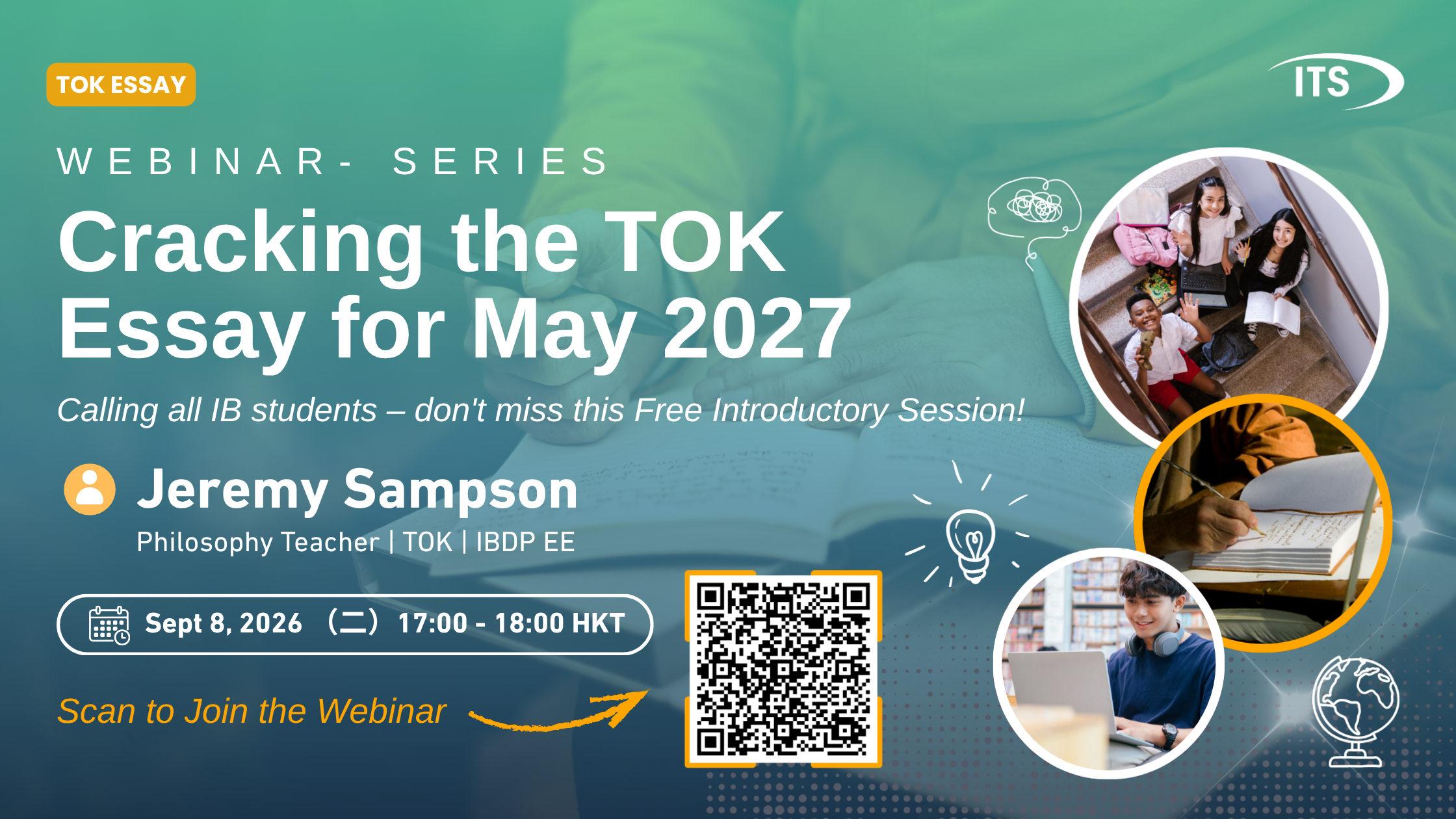
Calling all IB students – don't miss this Free Introductory Session!
系列講座—— IBDP 高分指南:TOK 寫作深度拆解