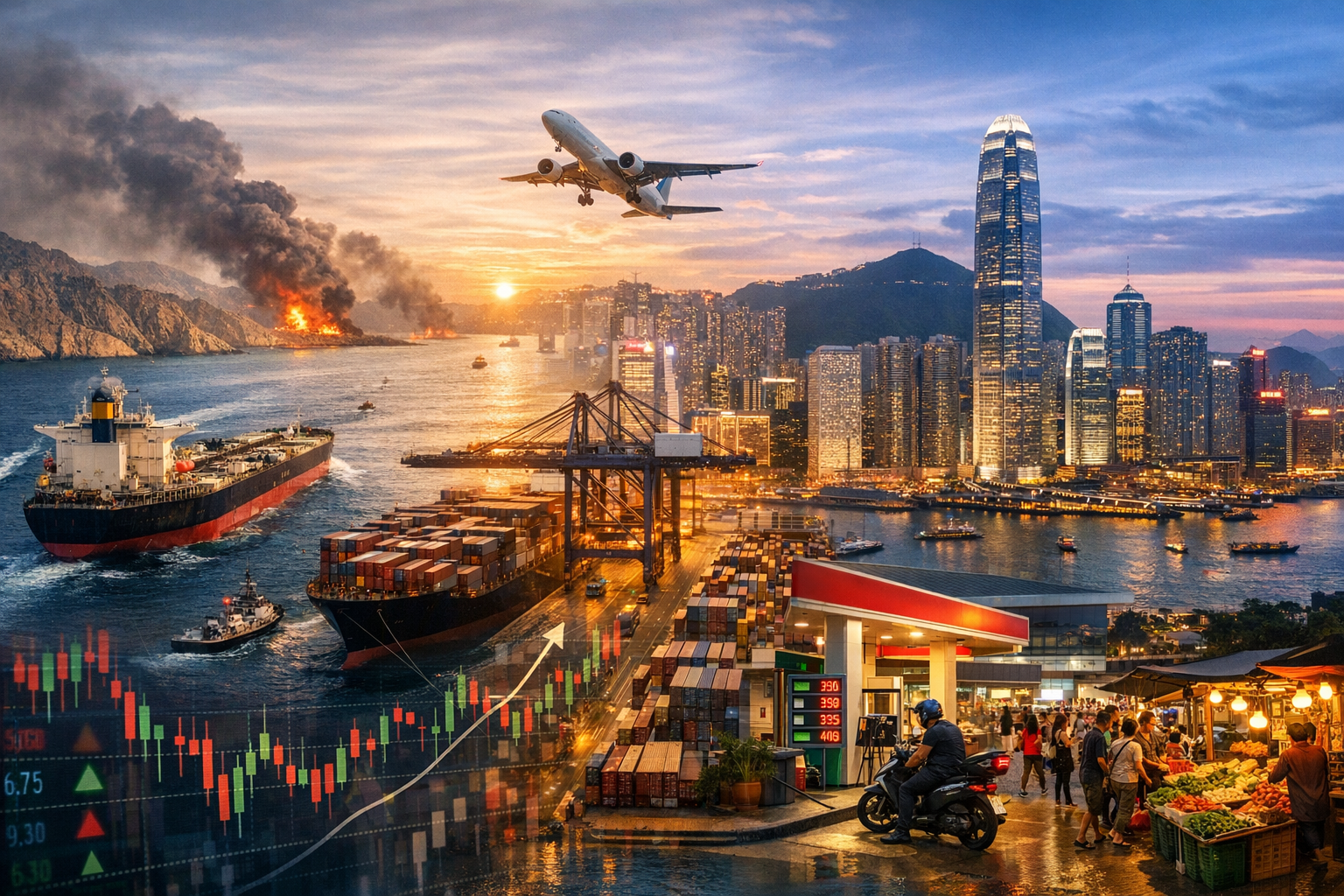
Image credit: AI Generated via Microsoft Copilot
This week has really got me thinking, this ‘conflict’ involving Iran and the resulting spike in fuel prices has once again shown how quickly the world can shift beneath our feet. For many adults, these movements feel like yet another cycle of geopolitical tension and economic reaction. But for young people, especially those growing up in Asia’s hyper?connected cities, this moment is a live demonstration of how the global economy actually behaves. It is a reminder that events unfolding thousands of kilometres away can influence the cost of food, transport, and daily life almost instantly. And it is exactly the kind of real?world complexity that students need to learn to read, interpret, and respond to.
What makes this situation so instructive is not just the politics, but the way markets react to uncertainty. The Strait of Hormuz is a narrow corridor, yet it carries a significant portion of the world’s oil supply. When conflict threatens that passage, prices rise before any physical disruption occurs. Students often imagine economics as something driven by numbers and production, but moments like this reveal a deeper truth: the as it is by physical goods. Understanding this helps young people see that the world is not governed by simple cause and effect. It is governed by perception, confidence, and the speed at which information travels.
As fuel prices rise, the effects ripple outward in ways that touch every part of life. Transport becomes more expensive, which affects shipping and aviation. Manufacturing costs increase. Food prices shift. Inflation data changes. Governments adjust policy. Suddenly, a conflict in the Middle East is influencing the cost of living in Hong Kong, Singapore, and every other import?dependent economy. For students, this is a powerful reminder that energy is not just a commodity. It is the foundation of modern life, and its price shapes everything from the cost of school lunches to the affordability of family holidays.
But beyond the economics, there is a deeper lesson here about the structure of the world students are inheriting. The Iran conflict exposes how vulnerable global supply chains remain, even after the disruptions of the pandemic. Despite years of discussion about diversification and resilience, the world still relies heavily on a few critical routes and suppliers. When one of those nodes becomes unstable, the entire system feels the shock. For young people, this is a chance to understand that efficiency alone is no longer enough. The future will belong to those who can think in terms of resilience, adaptability, and long?term sustainability.
This is where ITS Education Asia can play a meaningful role. Our work with students is not just about academic preparation. It is about helping young people develop the mindset and analytical tools needed to navigate a world defined by uncertainty. When we teach students to map how a single event affects multiple sectors, or to compare how different countries respond to the same crisis, we are giving them the ability to see patterns that others miss. When we encourage them to think in scenarios rather than predictions, we are helping them build the mental flexibility that modern leadership demands. And when we guide them to consider the ethical and environmental dimensions of energy and conflict, we are helping them grow into citizens who understand that global issues are never just economic or political — they are human.
The Iran conflict and the resulting fuel?price turbulence are not simply news stories. They are opportunities for young people to practise reading the world as a system. They show that global events are not distant or irrelevant, but deeply connected to the choices we make, the careers we pursue, and the futures we imagine. At ITS Education Asia, we want students to see these moments not as sources of anxiety, but as invitations to think more deeply, ask better questions, and recognise their own capacity to shape the world they will one day lead.