

Calling all IB students – don't miss this Free Introductory Session!
- Tue, 8 Sep 2026
- 17:00 – 18:00 HKT
- Online via Zoom
系列講座—— IBDP 高分指南:TOK 寫作深度拆解
- 2026年9月8日(星期二)
- 17:00 – 18:00 HKT
- Zoom 會議


About Me
I’m Jeff, an CS/AI undergraduate at Carnegie Mellon. My area of interest in AI is primarily NLP, the lingual aspects of Computer Science. This is because I always found myself trying to make sense of systems in motion. These were systems that would adapt and change over time; language seemed to be that sort of system. In my free time, I catch up with friends, go on trail runs, watch Netflix, but always make time to read. My favourite writers include Dickens, Orwell, and the late Christopher Hitchens (not in that order): whose articles and essays I found are just as entertaining as their novels or best-sellers. These interests are probably why I’m working on the CRED Initiative, a tech-based response to media misinformation.
Project Description
Increased media misinformation is negatively impacting public understanding: on topics such as Climate Change, Covid-19, Political Activism, public reputation etc. This initiative will provide the public with an easy-to-use tool (browser-extension) to identify misinformed media articles, comparing it to other articles and placing the article’s claims on a spectrum of consistency, using modern NLP techniques. The scope of this project will focus on articles related to Climate Change, to achieve proof-of-concept before applying to varied other topics.
CRED represents our initiative’s four main objectives: Context, Reputation, Evaluation and Dissent.
Context: Our browser extension aims to provide context to various media articles. With the click of a button, a user would be able to see a quantifiable figure, representing the similarity of claims to other articles. With the click of another button, the user could see detailed information regarding their article’s claims. It would include a line diagram, representing the spectrum of articles with various claims, for visual clarity; this would allow users to navigate the diverse landscape of opinions, in an accessible way.
Reputation: One use of this growing measure of article context is keeping track of media outlets’ leanings toward and from the mainstream opinion. This will provide users with a general guideline toward media outlets’ inclinations on mainstream or deviant opinions.
Evidence: Evidence is the panacea for misinformation. In the process of accessing detailed information, users will be provided with full links to articles from which their context scores were derived. This is done both as an additional resource for users as well as a matter of transparency.
Dissent: The program will include a ‘Devil’s Advocate’ feature. That is, using the information on the correlation between articles, our program would recommend articles of a different point of view, or at least, the ‘most’ radically different view of the topic at hand. The system will be carefully designed to trail the fine line between contrarianism and fake news. However, done properly, it would provide a valuable tool for users to explore pieces outside their normal consumption.


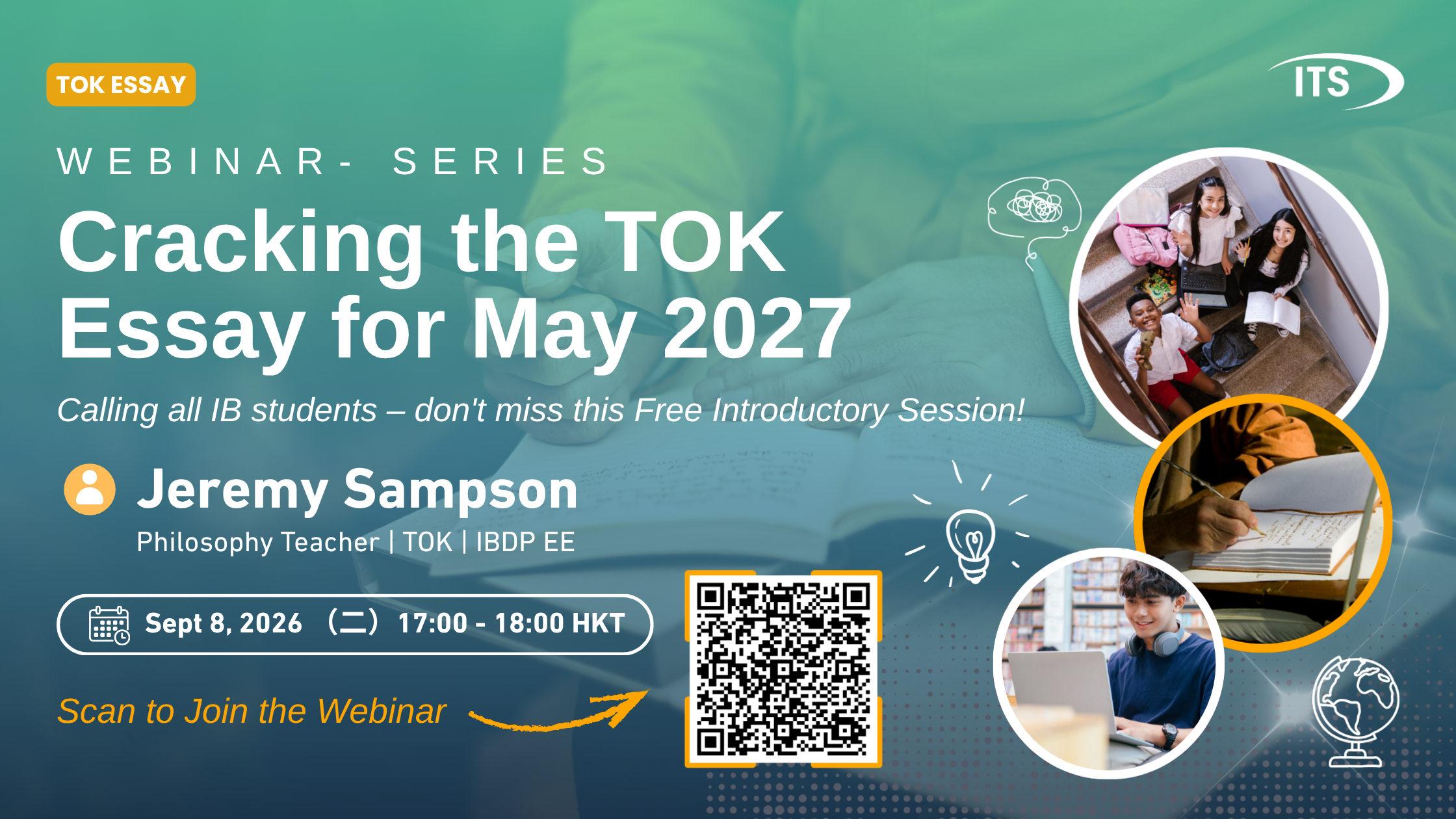
Calling all IB students – don't miss this Free Introductory Session!
系列講座—— IBDP 高分指南:TOK 寫作深度拆解