






Our Recommended Learning Tracks
We structure our support into targeted pathways designed to give students and parents clear, high-impact options to achieve their top academic potential.
1-to-1 Subject Tuition
Highly customised private tuition mapped out completely around the student's individual school syllabus, specific pain points, and target learning pace.
- Individual subject support tailored to your budget
- One-to-one adaptive learning environment
- Flexible scheduling based at Hong Kong or Online
- Pre-IB course support also available, if needed
Full Core & Essay Support
Dedicated consultancy sessions tackling the most complex, non-exam components required to achieve a full diploma qualification successfully.
- Complete Extended Essay (EE) guidance
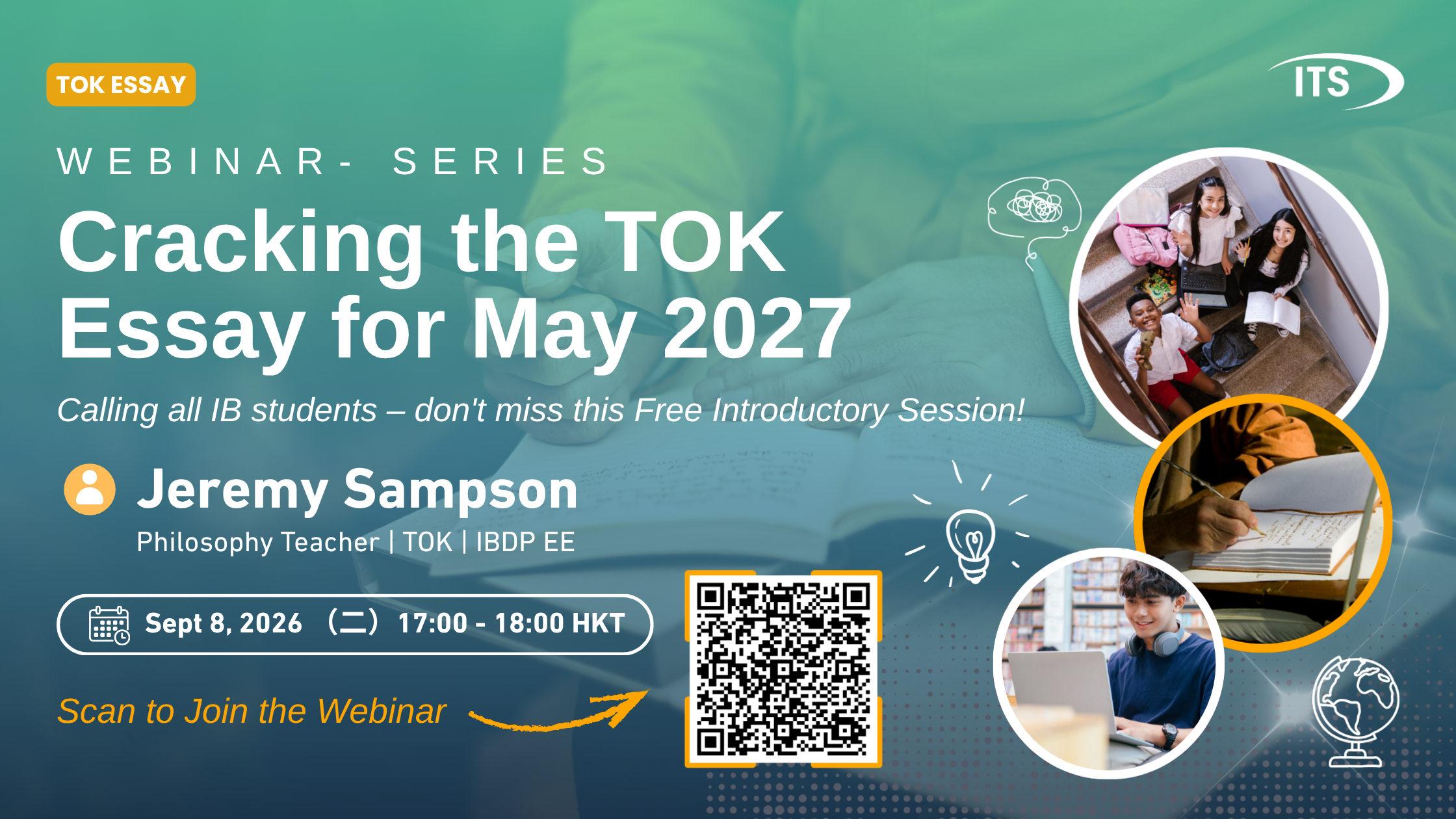
- TOK presentation and essay strategy
- Internal Assessment (IA) requirements mapping
First Lesson Trial
Students have taken over 40,000 hours of IB support tuition with ITS, both at our schools in Hong Kong and online. Our teachers are highly-qualified and experienced (and many of them are, or have been, official IB examiners).
Almost every year, an ITS student is one of the few globally who score a perfect 45 on the IB Diploma Programme. But whether you want to get 45 or simply ensure you get the grades you need, ITS tutorials are the way to go.
Similarly, we provide full support for Middle Years Programme (MYP). Our students take a range of courses for both the Diploma and MYP, including one-to-one and small group tuition, to suit every need and budget.
Students Get Help From Our Teachers For
A complete support net across every requirement of the Diploma Programme — from individual subjects to the compulsory core.
Individual IB subject(s) tuition
Extended Essay (EE) support
TOK (Theory of Knowledge) essay and presentation
Internal assessment requirements
English World Literature requirements
Oral language requirements
Practice exams
Proofing/editing services – ITS will never condone plagiarism or ghost-writing of any kind. Essay support including proofing and editing is done on a consulting basis where advice is given through discussion. Please don't ask us to write your work for you.
Which IB Subjects Does ITS Support?
Every IB subject group at a glance — expand your options across Standard Level (SL) and Higher Level (HL).
- Language A: literature (SL/HL)
- Language A: language and literature (SL/HL)
- Literature and performance (SL)
- Language ab initio (SL) French, Spanish, Chinese
- Language B (SL/HL) French, Spanish, Chinese
- Business management (SL/HL)
- Economics (SL/HL)
- Geography (SL/HL)
- Global Politics (SL/HL)
- History (SL/HL)
- Information Technology in a Global Society (SL/HL)
- Philosophy (SL/HL)
- Psychology (SL/HL)
- Social and Cultural Anthropology (SL/HL)
- World Religions (SL)
- Biology (SL/HL)
- Computer Science (SL/HL)
- Chemistry (SL/HL)
- Design Technology (SL/HL)
- Physics (SL/HL)
- Sports, Exercise and Health Science (SL/HL)
- Mathematical Studies SL
- Mathematics SL
- Mathematics HL
- Further Mathematics HL
- Not Supported
- Our Young Changemaker Incubator (YCI) programme can also be used to meet your IB Diploma CAS requirements. Check out our YCI page for more details.
- We provide EE support for all the subjects listed in the menus above.
- We provide TOK support using content from all the subjects listed in the menus above.
Useful Information About the IB Diploma
International Baccalaureate: what it is
The International Baccalaureate (IB) Diploma Programme is an internationally recognised qualification for students aged 16 to 19. It is based around detailed academic study of a wide range of subjects, including languages, the arts, science, maths, history and geography.
It leads to a single qualification, rather than separate qualifications for individual subjects. However if you don't achieve the full diploma, you'll be awarded a certificate for each subject taken.
It's designed to encourage you to:
- learn how to learn
- ask challenging questions
- develop a strong sense of your own identity and culture
- develop the ability to communicate with and understand people from other countries and cultures
The IB Diploma Programme is at level 3 on the UK National Qualifications Framework — equivalent to A-levels and BTEC Nationals which also gain you entry to university.
What you will study
The IB Diploma Programme is made up of a compulsory 'core', plus six separate subjects where you have some choice over what you study.
Compulsory core
The compulsory core contains three elements:
- theory of knowledge: you'll learn about the bases of knowledge, and how to analyse evidence and express yourself in rational argument; you'll also be encouraged to draw on experiences you've gained outside the classroom
- creativity, action and service: this part of the programme encourages you to get involved in theatre or music activities, sports and/or community service
- extended essay: you'll investigate a particular topic of interest and be asked to write a 4,000 word essay about it
Optional subjects
As well as the three core elements, you'll also select one subject from each of the following six areas:
- first language (normally your mother tongue)
- second language (this could be a language you already study, or a new one)
- experimental sciences (biology, chemistry, physics, design technology)
- mathematics and computer science
- the arts (visual, music and theatre)
- individuals and society (history, psychology, geography)
Normally, you'll study three of your six optional subjects at a 'higher' level (240 teaching hours per subject), and the other three at a 'standard' level (150 teaching hours). However, you can also opt to take four subjects at the higher level and two at the standard level.
How you are assessed
Most of the assessment is done through exams, marked externally. However, in nearly all subjects, some of the assessment is carried out by your teachers, who mark individual pieces of coursework – the IAs or Internal Assessments.
The Diploma normally takes two years to complete, with exams taking place in May and November.
Points
You are awarded points for each part of the programme, up to a maximum of 45:
- up to seven points for each of the six optional subjects you take
- up to three points from your performance in the core elements
(×6 subjects)
Core Elements
Diploma Score
To achieve a full diploma, you must score 24 points or more.
UCAS Tariff
Successfully completing the Diploma earns points on the 'UCAS Tariff' for getting into higher education.
An IB Diploma total of 24 points is worth 260 UCAS points – the same as a 'B' and two 'C' grades at A-level. The maximum of 45 points earns 720 UCAS points – equivalent to six A-levels at grade 'A'.
Here is more information on the UCAS Tariff Tables.
Retakes
If you are not happy with your results, you can retake one or more Diploma subject. The higher mark from your two attempts will count towards your Diploma points score. But think carefully before you jump into retakes; they are not always the only, or the best, option. Make an appointment with an ITS counselor to help make decisions on what to do if your IB grades turn out lower than you expected or needed.
Where it can lead
Most students who take the IB Diploma Programme go on to higher education; the qualification is recognised by universities in more than 100 countries.
However, you may be asked to gain a certain number of points at the 'higher' level in specific subjects if you want to study a particular course. ITS is a full UCAS Centre so you can ask us about all the options that are open to you using the IB Diploma to access higher education in the UK.
Ready to Start Your IB Journey?
Get expert guidance from highly qualified instructors and official IB examiners at our Hong Kong center or online.