

Calling all IB students – don't miss this Free Introductory Session!
- Tue, 8 Sep 2026
- 17:00 – 18:00 HKT
- Online via Zoom
系列講座—— IBDP 高分指南:TOK 寫作深度拆解
- 2026年9月8日(星期二)
- 17:00 – 18:00 HKT
- Zoom 會議

A B C D E F G H I J K L M N O P Q R S T U V W X Y Z
Wada test: a technique to anaesthetise one hemisphere of the brain at a time, by injecting a short-acting anaesthetic (sodium amytal) into the carotid artery serving one hemisphere, then a short time later repeating the procedure for the other hemisphere, in order to see which hemisphere is important for language in participants.
WAIS: see Weschler Adult Intelligence Scale.
weapon focus effect: the tendency for witnesses to a crime involving a weapon (e.g. gun) to recall details of the weapon, but to be less accurate on other details such as the perpetrator's face.
Weber's Law: is a law of psychophysics which states that the amount by which a stimulus must change in order for that change to be noticeable is proportional to the intensity of that stimulus. Thus, stronger stimuli would need to be increased by greater amounts than would weaker stimuli for noticeable change.
Wernicke's aphasia: caused by damage to Wernicke's area in the brain, resulting in disruptions in processing and comprehension of speech input, whilst speech production remains unimpaired. See also Broca's aphasia.
Wernicke's area: area of the left temporal cortex Wernicke proposed to be the centre of language comprehension, whereby sound patterns of words are stored, in order to convert speech sounds into words.
Weschler Adult Intelligence Scale: an intelligencetestwhich measures elements of adult intelligence, including verbal intelligence and performance intelligence, which are then divided into specific abilities so that an individual performance and any deficiencies can be assessed.
Weschler Intelligence Scale for Children: a version of the WAIS that measures IQ in children aged from six to 16 years.
will: the capability of conscious choice and decision and intention. Nietzschedefines will similarly to the "any internally motivated action" usage, but more narrowly. In this sense, will is more a "creative spark," a certain independence and stubbornness.
wish fulfilment: in Freud's theory, the symbolic manifestation of drives in fantasy form, as in dreams.
withdrawal: physically painful and unpleasant symptoms (such as vomiting, shaking, headaches and convulsions) suffered by a physically dependent drug user as the effects of a drug wears off.
withdrawal from investigation: an ethical requirement of psychological research that participants have the right to withdraw at any time during the study
within subjects design: see repeated measures design.
wolf children: or feral children,are children who have been found living in the wild, and often display animal-like behaviours, indicating they have been brought up by wild animals.
World Health Organisation (WHO) – an office of the UN which overseas international efforts to improve general health conditions and to address international threats such as pandemics. http://www.who.int/en/
word recognition threshold: is the minimum exposure of a word necessary to recognise and identify it. The threshold is set as the point at which the word can be correctly recognised 50 per cent of the time when presented.
working memory: a flexible memory system used for reasoning and language comprehension, that is comprised of the phonological loop, visuospatial sketchpad and central executive.
workplace stressors: aspects of the working environment (e.g. impending deadlines) that are experienced to be stressful, including physical stressors (such as noise, length of working day and inherent danger) and psychosocial stressors(such as relationships with coworkers, organisation of work, and role responsibility).
A B C D E F G H I J K L M N O P Q R S T U V W X Y Z







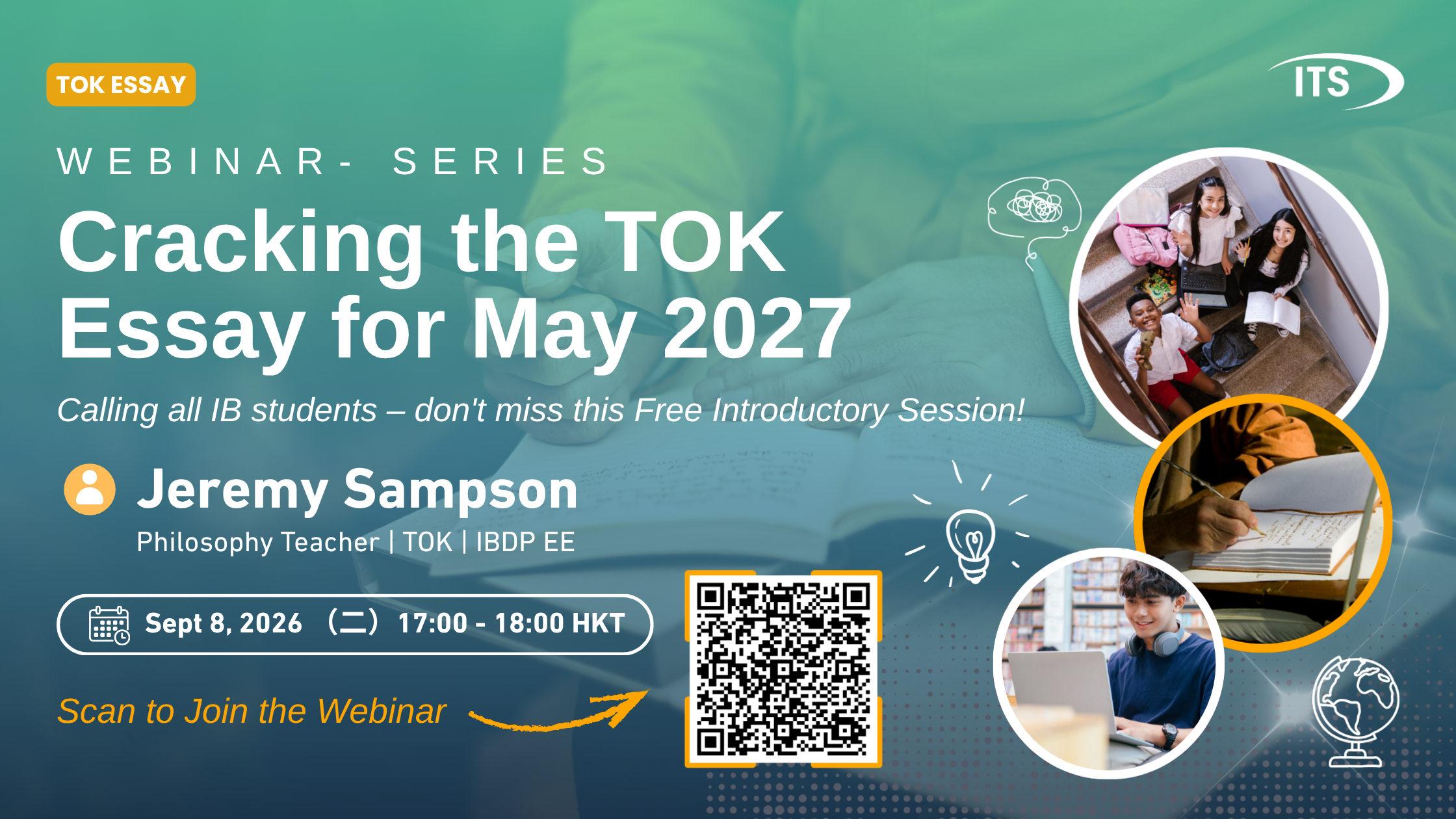
Calling all IB students – don't miss this Free Introductory Session!
系列講座—— IBDP 高分指南:TOK 寫作深度拆解