

Calling all IB students – don't miss this Free Introductory Session!
- Tue, 8 Sep 2026
- 17:00 – 18:00 HKT
- Online via Zoom
系列講座—— IBDP 高分指南:TOK 寫作深度拆解
- 2026年9月8日(星期二)
- 17:00 – 18:00 HKT
- Zoom 會議

A B C D E F G H I J K L M N O P Q R S T U V W X Y Z
ICD: see International Classification of Disorders.
id: in psychoanalytic theory, the unconscious, pleasure part of the personality that operates irrationally and pursues primitives drives such as anger and hunger.
ideal self: in Rogers's humanistic theory, an evolving construct which represents the goals and aspirations of an individual.
identical twins: see monozygotic twins.
idiographic: any approach or method in psychology that focuses on the individual rather than in the development of general laws of behavior (known as thenomothetic approach).
illogical: contrary to logic; lacking sense or sound reasoning.
illusion: perceptual experiences, through the senses, that are not true representations of the physical event.
illusory correlation: perceiving a relationship between variables where none exists.
imagination: is the ability to form mental images, or the ability to spontaneously generate images within one's own mind.
imaging techniques: see CAT, MEG, MRI and PET scans.
imitation: the learning of behaviour through the observation of others behaviour; sometimes called 'modelling' or 'observational learning' .
implosion therapy: a behavioural therapeutic technique to reduce a clientsphobia, through requiring the client to imagine the fearful stimuli. This operates on the premise of experiencing the feared situation through imagination, but in the safe context of the therapy session, in order to remove the anxiety associated with the stimuli.
impression management theory: refers to our desire to make a favourable impression on other people. We may adjust our behavior to appear positively to others, for instance, doing favours for others.
imprinting: a primitive type of learning that occurs during the early part of an animal's life, whereby an attachment is formed to another animal that is difficult to change (filial imprinting).
immune system: system of cells and chemicals within the body that defends against infection and disease, by seeking out and destroying harmful influences.
incentive: a stimulus that elicits goal directed behaviour.
incongruence: in Rogers's theory, a mismatch between the self and ideal selfresults in a feeling of conflict or unease.
incubation: in the Gestalt model of problem solving, a process of pausing to actively work on a problem, in order to modify one's mental set.
independent groups designs: used in experiments when separate groups of individuals participate in the different levels of the independent variable, so that each data set is independent of each other. Also known as a between subjects or unrelated design, as comparisons are made between groups rather than within them.
independent variable (IV): the variable that is manipulated in an experiment (e.g. type of words participants receive in a memory experiment) and consequently affects the dependent variable.
individualistic cultures: cultures where self-interest and individual rights are promoted, and is characterised by low levels of mutual interdependence between individuals, rather than the collective needs and interests of others.
induction: a process of reasoning based on forming general principles from specific observations.
inductive reasoning: is the process by which a conclusion is drawn about theprobability of psychological phenomena, based on evidence and past experience, from the specific to the general.
inferiority complex: in the fields of psychology and psychoanalysis, is a feeling that one is inferior to others in some way. Such feelings can arise from an imagined or actual inferiority in the afflicted person.
inferential statistics: procedures used to analyse empirical data to test if theindependent variable has had a significant effect upon the dependent variable, in order to either accept the hypothesis or to reject it, (thereby attributing the results to chance variation). Tests include Chi-square, Binomial Sign, Wilcoxon Matched Pairs, Mann-Whitney U, and Spearman's Rho.
informational (social) influence: occurs when we seek informational guidance from others in groups, as a result of the desire to be right.
informed consent: an ethical requirement that participants or clients should have sufficient information about an experiment or therapeutic intervention to enable them to make an informed judgement about whether or not to participate.
infradian rhythms: occur less frequently than once every 24 hours, for instance the human menstrual cycle.
in-group: a reference to any group of which we perceive ourselves to be a member, based on global dimensions (e.g. race, religion) or specific localised dimensions (e.g. friendship).
inhibition: 1) In reference to neurons, it is a synaptic message that prevents the recipient cell from firing. 2) In reference to behavior, restraint on instinctive impulses.
inhibitory: a process used to stop an action (stop a muscle from becoming stiff) by modifying sensory input.
innate: anything that is inherited or natural to an organism, existing at birth rather than acquired.
innovation (minority influence): a form of social influence, whereby the minority in a group have an influence over the majority. A number of conditions must be met, including holding a clear and confident position.
insecure attachment: a form of attachment between infant and caregiver that develops as a result of the caregiver's lack of sensitive responding to the infant's needs. The two types of insecure attachment are insecure/avoidant (children who avoid social interaction with others) and insecure/resistant (seek and reject social interaction).
insomnia: the unusually prolonged inability to fall asleep or difficulty staying asleep.
instinct: inborn pattern of behavior often responsive to specific stimuli; "the spawning instinct in salmon"; "altruistic instincts in social animals".
instrumental aggression: aggressive behavior that is goal directed in order to achieve specific aims.
intellect: the faculty of reasoning, knowing and thinking, as distinct from feeling; the understanding or mental powers of a particular person etc.
intellectual development: (Piaget) concluded that intellectual development is the result of the interaction of hereditary and environmental factors. As the child develops and constantly interacts with the world around him, knowledge is invented and reinvented. His theory of intellectual development is strongly grounded in the biological sciences. He saw cognitive growth as an extension of biological growth and as being governed by the same laws and principles. Piagetargued that intellectual development controlled every other aspect of development - emotional, social, and moral.
intelligence: an underlying ability which enables an individual to adapt to and function effectively within a given environment.
intelligence quotient (IQ): IQ is calculated by dividing mental age by chronological age (and multiplying by 100 to give a whole number), in order to compare the mental age of a child compared with their chronological age. It is now directly calculated as an IQ test score.
interdependence: when two or more things depend on each other.
interference theory: refers to the process that occurs when incoming information disrupts memory traces
International Classification of Disorders (lCD): a classification system of mental disorders published by the World Health Organisation. Patterns of symptoms as opposed to aetiology or treatment are emphasised, as a result, the ICD is not used for diagnostic purposes.
inter-observer reliability: a measure of the extent to which different individuals generate the same records when they observe the same sequence of behaviour. By correlating the scores of observers we can measure inter-observer reliability: individuals (or groups) with highly correlated scores are demonstrating good interobserver reliability.
interpersonal attraction: the study of factors and processes involved in the attraction between two people. As such it covers a wide range of different forms of attraction, including friendships, sexual attraction and romantic love.
interquartile range: the spread of scores for the middle 50 per cent of scores.
interval data: data with equal intervals, but not an absolute zero.
interview: usually a verbal research method consisting of either open or closedended questions.
intrinsic motivation: motivation based on taking pleasure in an activity rather working towards an external reward.
introspection: the process by which a person looks inward at their own mentalprocesses in order to gain insight into their personalities.
introversion: a part of the introversion-extroversion personality dimension associated with the personality theory of Eysenck. Introversion is associated with a reluctance to seek the stimulation of social contacts and to be generally more passive and controlled than extroverts.
IQ: see intelligence quotient.
irrational: contrary to or lacking in reason or logic.
A B C D E F G H I J K L M N O P Q R S T U V W X Y Z








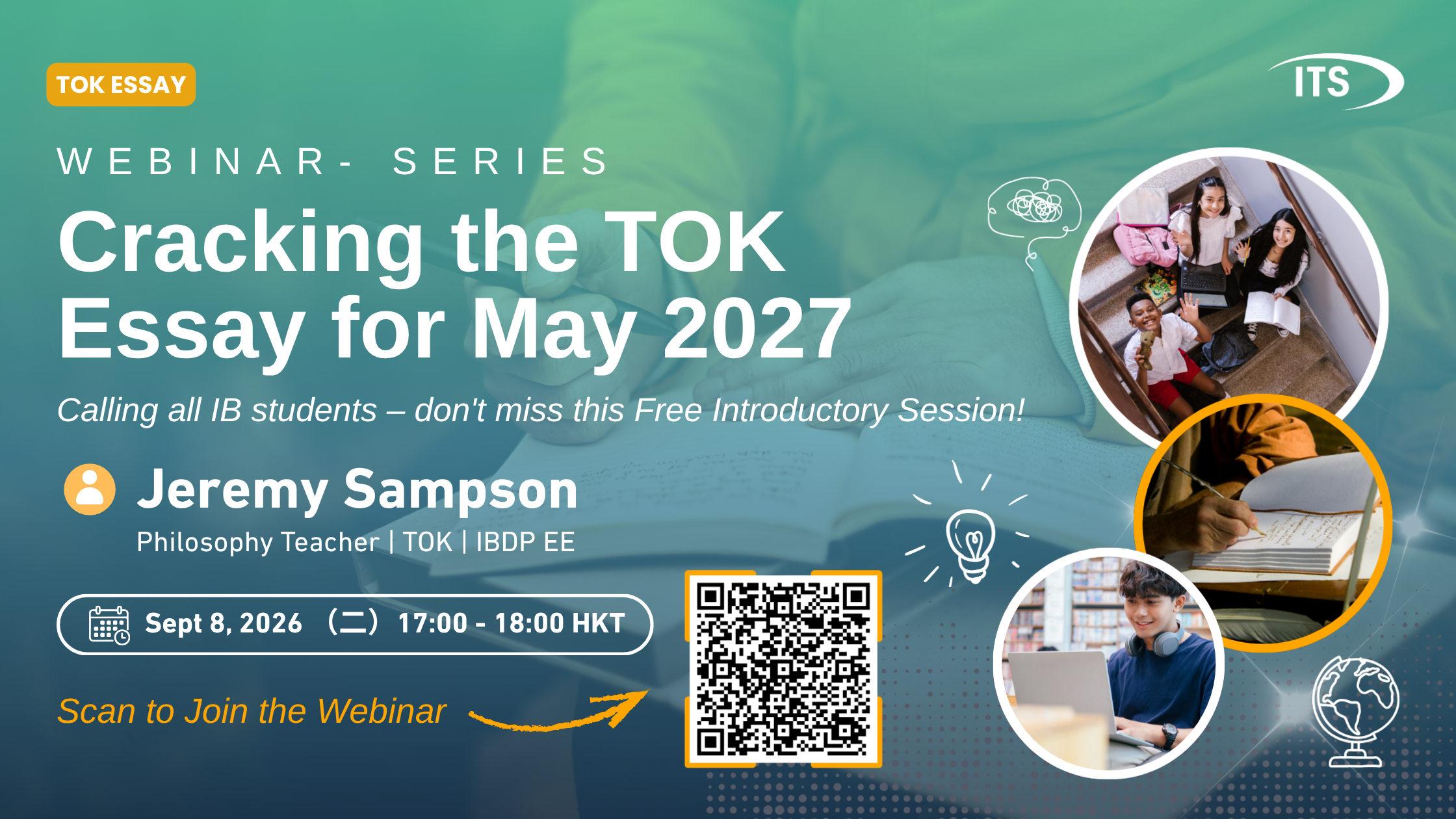
Calling all IB students – don't miss this Free Introductory Session!
系列講座—— IBDP 高分指南:TOK 寫作深度拆解